

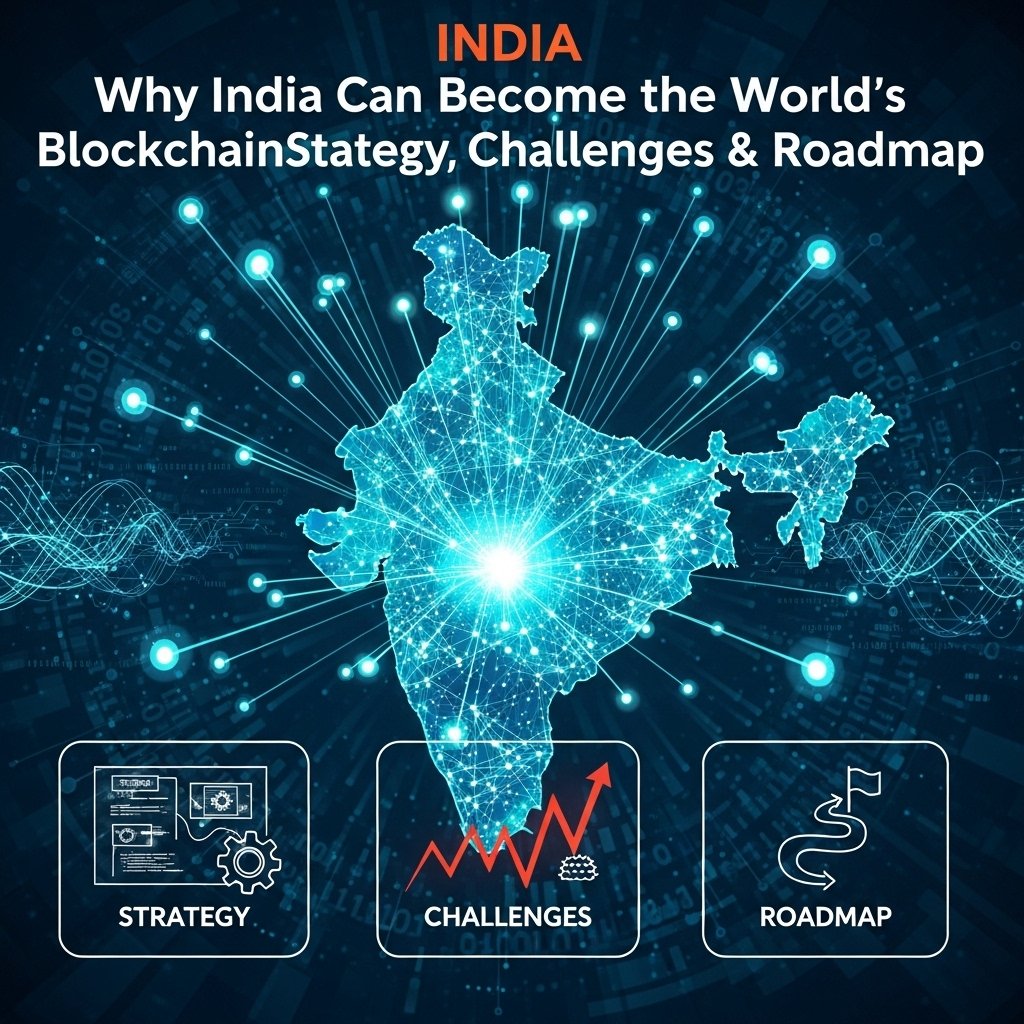
India has the talent, infrastructure, and ambition to emerge as the global hub for blockchain nodes. Here’s the strategy, roadmap, and risks India must navigate to lead Web3 infrastructure.
From Blockchain Use Cases to Blockchain Infrastructure
For much of the last decade, conversations around blockchain revolved around use cases: crypto payments, NFTs, DeFi, supply chain, and tokenized assets. But as blockchain networks matured, a quieter yet critical layer has emerged as the real battleground: infrastructure.
Every blockchain—Ethereum, Bitcoin, Polygon, Solana—relies on nodes (computers that validate, relay, and secure transactions). Whoever hosts these nodes, data centers, and relays isn’t just participating—they’re shaping the backbone of the decentralized economy.
This is where India enters the story. With its vast developer base, growing digital economy, and geopolitical positioning, India has a chance to move beyond being just a consumer of blockchain and become a global blockchain node hub.
India’s Advantages: Why the Timing Is Right
- Talent Pool
India produces more than 1.5 million engineers annually and is home to one of the world’s largest Web3 developer ecosystems. This is not just raw numbers—India’s tech talent has powered global software firms and blockchain startups alike. - Digital Infrastructure Growth
India has already demonstrated world-class digital public goods like UPI (Unified Payments Interface) and Aadhaar. The data center boom—led by investments from Reliance, Adani, Yotta, and global players—is laying the physical backbone. - Geography & Connectivity
Strategically located between East and West, India could serve as a relay hub for blockchain traffic across Asia, the Middle East, and Africa. Its expanding submarine cable landings further enhance this potential. - Cost Advantage
Hosting costs, while rising, are still significantly lower than in the U.S. or Europe, making India attractive for large-scale node deployments.
The Challenges India Must Overcome
- Energy & Sustainability
Blockchain nodes—especially validator or mining nodes—consume energy. Without clear green-energy policies, India risks backlash for adding carbon load to an already stressed grid. - Regulatory Ambiguity
While the government is warming to blockchain (for trade, logistics, and public administration), crypto regulation remains fragmented. Node operators need clear guidelines to operate without fear of sudden crackdowns. - Trust & Security
Global networks require that nodes be secure, reliable, and censorship-resistant. India must improve cybersecurity resilience and ensure international trust in its hosting standards. - Capital & Incentives
Running industrial-scale node infrastructure requires heavy upfront capital. Without subsidies, tax incentives, or PPP (public-private partnership) models, India risks losing to countries with more aggressive policies.
Roadmap: How India Can Lead
- Regulatory Clarity & Separation
- Create distinct legal frameworks for blockchain infrastructure (nodes, validators, relays) vs. crypto trading & speculation.
- This separation encourages institutional investors and hosting providers to set up nodes without fear of crypto-market volatility spillover.
- Green Power Integration
- Offer renewable energy credits and subsidies for data centers hosting blockchain nodes.
- Position India as the leader in green blockchain infrastructure, akin to how Iceland markets geothermal-powered mining.
- Public-Private Partnerships
- Collaborate with universities, tech giants, and startups to create Blockchain Infrastructure Parks—zones with subsidized energy, high-speed fiber, and regulatory sandboxes.
- Global Collaboration
- Partner with blockchain foundations (Ethereum Foundation, Solana Labs, etc.) to make India a preferred location for testnets, devnets, and validator bootstrapping.
- Academic Integration
- Encourage IITs, IIITs, and IIMs to include blockchain infrastructure courses, ensuring the next wave of DevOps, cybersecurity, and distributed systems experts are node-ready.
Learning from Other Nations
- Iceland: Marketed its geothermal energy to attract Bitcoin mining, turning its natural resources into economic strength.
- Estonia: Built a reputation as the “digital nation” by embedding blockchain into e-governance, proving that trust + policy can create outsized influence.
- Singapore: Used regulatory clarity and pro-innovation frameworks to become Asia’s fintech and blockchain hub.
India can borrow elements from all three—sustainability, trust, and clear policy—to build its own model.
Risks India Must Watch
- Centralization Risk: If a few corporate giants dominate hosting, India may replicate Web2 monopolies under the guise of decentralization.
- Geopolitical Pressure: Hosting global blockchain nodes could put India in the crosshairs of U.S., EU, or Chinese digital sovereignty concerns.
- Regulatory Overreach: Excessive taxation or surveillance could deter international players.
Bottom Line
Blockchain infrastructure is the new oil pipeline of the digital age. Just as nations competed to build ports, railroads, and telecom networks in earlier eras, the competition today is about who hosts and secures the digital commons.
India, with its talent, cost advantage, and digital ambition, is well-placed to rise as a global blockchain node hub. But this won’t happen by default—it requires clear policies, sustainability planning, and bold partnerships.
If done right, India won’t just participate in Web3—it could anchor its very backbone.
